


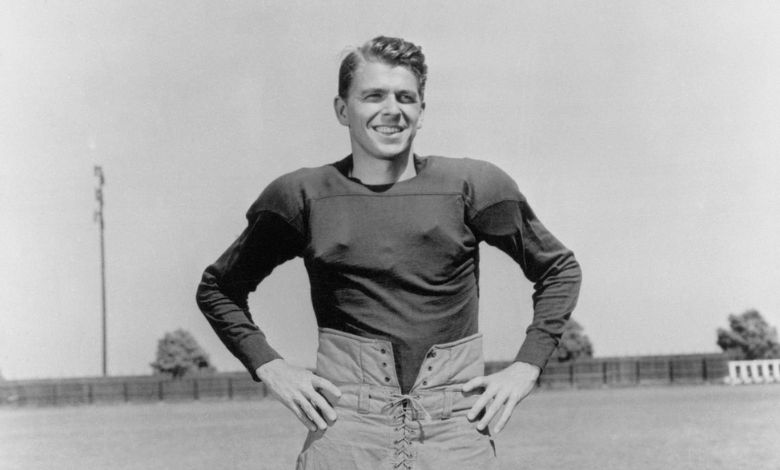
George Gipp was an American college football player whose achievements helped establish the University of Notre Dame as a major force in the sport. Nicknamed “the Gipper,” he played for Notre Dame from 1917 through 1920 and became known for contributing as a runner, passer, punter, kicker, returner, and defensive player.
Gipp played under Knute Rockne, who became Notre Dame’s head coach in 1918. During Gipp’s final two seasons, the Fighting Irish completed consecutive undefeated campaigns. His combination of rushing, passing, and special-teams ability made him one of the most versatile players of early college football.
In 1920, Gipp became Notre Dame’s first player selected to Walter Camp’s All-America team. He died from complications associated with a severe throat infection and pneumonia on December 14, 1920, at age 25.
His reputation later expanded beyond his documented playing career. Rockne’s “Win one for the Gipper” speech, delivered before Notre Dame defeated Army in 1928, turned Gipp into a lasting symbol of motivation and sacrifice. However, historians have questioned whether the deathbed words attributed to him were spoken exactly as Rockne later presented them.
Also Read: Ronnie Platt Biography: Age, Kansas Career, and Songs
Featured Snippet: Who Was George Gipp?
George Gipp was an American college football player who represented the University of Notre Dame from 1917 to 1920. Known as “the Gipper,” he played several positions under coach Knute Rockne and became Notre Dame’s first Walter Camp All-American. He died in 1920 at age 25.
What position did George Gipp play?
George Gipp was primarily a halfback, a position broadly comparable to a modern running back. He also handled quarterback duties, passed the ball, punted, kicked, returned kicks, and played defense. His varied responsibilities reflected both his athletic range and the two-way nature of early college football.
How did George Gipp die?
George Gipp died at St. Joseph Hospital in South Bend, Indiana, on December 14, 1920. Reports during his illness referred at different times to tonsillitis, a streptococcal throat infection, and pneumonia. He died before antibiotics such as penicillin were available for routine medical treatment.
Did George Gipp really say “Win one for the Gipper”?
Knute Rockne said that Gipp made a final request that Notre Dame should someday “win one for the Gipper.” Rockne repeated the story before the 1928 Army game. Notre Dame archives note that historians doubt whether Gipp spoke the exact words later attributed to him.
Why is George Gipp famous?
George Gipp is famous for his versatile Notre Dame football career, his 1920 All-American selection, and his connection to Knute Rockne’s celebrated motivational speech. His fame grew further when Ronald Reagan portrayed him in the 1940 film Knute Rockne, All American.
Did George Gipp play professional football?
No verified record shows George Gipp playing professional football. His reputation was built entirely through his college career at Notre Dame. He became seriously ill shortly after the 1920 season and died at age 25, before he could pursue a professional athletic career.
George Gipp Profile Summary
| Profile field | Verified information |
|---|---|
| Full name | George Gipp |
| Nickname | The Gipper |
| Date of birth | February 18, 1895 |
| Birthplace | Laurium, Michigan, United States |
| Date of death | December 14, 1920 |
| Age at death | 25 |
| Place of death | South Bend, Indiana, United States |
| Nationality | American |
| Parents | Matthew Gipp and Isabella Gipp |
| Profession | College football player |
| University | University of Notre Dame |
| Playing years | 1917–1920 |
| Primary position | Halfback |
| Other roles | Quarterback, passer, punter, kicker, returner, and defensive player |
| Head coach | Knute Rockne |
| Major recognition | Walter Camp All-American, 1920 |
| Hall of Fame | College Football Hall of Fame, 1951 |
| Burial place | Lake View Cemetery near Calumet, Michigan |
| Best known for | Notre Dame football career and the “Win one for the Gipper” story |
Early Life and Background
George Gipp was born on February 18, 1895, in Laurium, a community in Michigan’s Upper Peninsula. Historical records identify his parents as Matthew and Isabella Gipp. He grew up in the Calumet and Laurium area, which developed around the region’s copper-mining industry.
Detailed and consistent records about his childhood are limited. Historical accounts generally describe him as naturally athletic and interested in several sports. Football was not necessarily his only or original athletic focus. Baseball and other competitive activities also formed part of his early reputation.
Gipp’s rise was unusual because he did not follow the carefully organized athletic path associated with modern college recruits. His abilities became more apparent after he reached Notre Dame, where his kicking, running, and passing skills attracted attention.
Education
Gipp attended public schools in the Calumet and Laurium area. Notre Dame historical reporting indicates that he did not complete high school and entered the university as a conditional freshman, an admission category that was possible during that period.
He attended the University of Notre Dame but is not known to have earned a degree. Accounts of his university years describe academic difficulties and an inconsistent relationship with formal campus expectations.
These details should be presented within their historical setting. Admission rules, athletic eligibility standards, and university procedures in the 1910s differed considerably from those governing college athletes today.
Notre Dame Career and Professional Journey
Beginning His Football Career
Gipp began playing varsity football for Notre Dame in 1917. Knute Rockne became head coach the following year and gradually developed a program that emphasized preparation, tactical innovation, and national competition.
Although Gipp is commonly listed as a halfback, he did not perform the narrow role associated with a modern specialist. He ran with the ball, passed, punted, kicked, returned kicks, and contributed on defense. Early football frequently required leading players to remain on the field for both offensive and defensive possessions.
His ability to perform several tasks gave Notre Dame tactical flexibility. Gipp could gain ground as a runner, change field position as a punter, or attempt passes at a time when the forward pass was used less frequently than it is today.
Undefeated Seasons in 1919 and 1920
Gipp’s most successful team seasons came in 1919 and 1920. Notre Dame completed both campaigns with perfect 9–0 records.
These undefeated seasons helped the university gain broader national attention. Notre Dame was developing from a respected Midwestern program into a nationally recognized football institution, and Gipp became its most prominent player.
His statistical production demonstrated that he was more than a figure created by later storytelling. According to the National Football Foundation, Gipp rushed for 2,341 yards during four varsity seasons. The total remained a Notre Dame career record until 1978.
He also completed 93 passes for 1,769 yards and scored 156 career points through touchdowns, extra points, and field goals. In addition, he punted and returned kicks.
Statistics from the early 20th century should be interpreted carefully because recordkeeping was less standardized than it is now. Nevertheless, the available official totals show an unusually broad contribution across several areas of play.
The 1920 Army Game
One of Gipp’s most frequently discussed performances came against Army in 1920. Notre Dame’s games against Army carried national importance because the military academy was already an established football power.
Gipp contributed in several phases of the game, reinforcing his reputation as an all-purpose player. The performance became part of his broader career narrative and strengthened the connection between Gipp, Notre Dame, and the Army rivalry.
That rivalry later provided the setting for the 1928 game in which Rockne used Gipp’s memory to motivate his team.
Major Achievements and Recognition
Notre Dame’s First Walter Camp All-American
Gipp received his most important contemporary honor in 1920 when Walter Camp selected him as an All-American. Camp was one of the leading authorities in the development and promotion of American football, and his selections carried substantial national influence.
Gipp is recognized as Notre Dame’s first Walter Camp All-American. The honor reflected his performance as a runner, passer, kicker, and all-around player rather than his later connection to a famous speech.
Career Records
Gipp finished his Notre Dame career with 2,341 rushing yards. That school record lasted for more than half a century before it was surpassed in 1978.
His career passing total of 1,769 yards was also significant for an era in which passing was far less central to offensive strategy. His production in both categories supports his standing as one of Notre Dame’s earliest multidimensional stars.
College Football Hall of Fame
George Gipp was inducted into the College Football Hall of Fame in 1951. The honor formally recognized his place among the important players in the development of college football.
His induction rested on his documented athletic accomplishments: four varsity seasons, major offensive production, consecutive undefeated campaigns, and national All-American recognition.
Local Memorials
Gipp has also been commemorated in his home region. George Gipp Memorial Park in Laurium preserves his connection to Michigan’s Upper Peninsula. He is buried at Lake View Cemetery near Calumet, Michigan.
These local memorials reflect how his legacy operates at two levels. He remains a national figure in college football history while also serving as a prominent historical figure from the Keweenaw Peninsula.
Illness and Death
Gipp’s final illness was first reported near the end of November 1920. He did not travel with Notre Dame for its season-ending game against Michigan Agricultural College, now Michigan State University.
Reports about his condition changed as the illness developed. It was initially described as tonsillitis, while later accounts referred to strep throat, pneumonia, or a combination of related complications. He was treated at St. Joseph Hospital in South Bend.
Gipp died during the early morning of December 14, 1920. He was 25 years old.
Medical treatment for serious bacterial infections was limited at the time. Penicillin had not yet entered general clinical use, making throat infections and pneumonia considerably more dangerous than they became in later decades.
A popular story claims that Gipp became ill after being locked out and sleeping outdoors. That account is widely repeated but should not be treated as a confirmed medical explanation. The surviving reports support the presence of a serious throat infection and pneumonia but do not establish one certain moment when he contracted the illness.
His death produced a major reaction at Notre Dame. Classes were canceled so students could attend a memorial Mass, and members of the university community accompanied his coffin to the railway station before it was returned to Michigan.
Personal Life
Reliable public information about George Gipp’s private relationships is limited. Institutional biographies and established football histories focus mainly on his athletic career, university years, illness, and influence on Notre Dame football.
The principal historical sources do not provide a well-documented record of a marriage, spouse, or children. Claims about his private relationships should therefore be treated cautiously unless they are supported by archival or legal documentation.
Several historical profiles describe him as independent and resistant to university discipline. However, those descriptions often come from memories recorded years after his death. They offer context about how others viewed him but should not replace verified information about his playing career.
Philanthropy and Public Engagement
There is no substantial public record showing that Gipp established a charity, led a formal philanthropic initiative, or maintained an organized public-service role.
His life was brief, and he died while still associated with Notre Dame. Some later recollections describe individual acts of generosity, but there is not enough consistent documentation to present philanthropy as a defined part of his public career.
“Win One for the Gipper”
The phrase most closely connected with George Gipp originated from a story told by Knute Rockne. According to Rockne, Gipp asked from his hospital bed that, when Notre Dame faced a difficult situation in the future, the team should win a game for him.
Rockne used the story at halftime of Notre Dame’s November 10, 1928, game against Army. Notre Dame trailed 6–0 before recovering to win 12–6.
The victory helped turn the speech into one of the best-known stories in American sports. However, Notre Dame’s own archives state that historians doubt whether Rockne’s version represented Gipp’s exact final words.
The most accurate interpretation is that the speech is historically important even though its central quotation cannot be independently confirmed. It reveals how Gipp’s memory was used within Notre Dame football culture, but it should not be presented as a fully verified transcript of a private hospital conversation.
Also Read: Kevin Clay Biography: Age, Broadway Career, and Elder Price
George Gipp in Film and Popular Culture
Gipp’s story reached a much larger audience through the 1940 film Knute Rockne, All American. Ronald Reagan portrayed Gipp, while Pat O’Brien played Knute Rockne.
The film dramatized the hospital conversation and Rockne’s later motivational speech. Its popularity helped establish “Win one for the Gipper” as an expression used well beyond football.
Reagan remained associated with the role throughout his later political career and was himself sometimes called “the Gipper.” This association has occasionally caused confusion between the historical player and the actor who portrayed him.
George Gipp was the real Notre Dame athlete. Ronald Reagan’s connection came from playing him in a film released approximately 20 years after Gipp’s death.
Public Perception and Misconceptions
Misconception: Gipp was mainly famous because of a quotation
The famous phrase increased his cultural visibility, but Gipp had already earned national recognition through football. His All-American selection, career rushing record, passing production, and role on undefeated teams were established before the speech became famous.
Misconception: Gipp played in the NFL
Gipp did not have a documented professional football career. His achievements came at Notre Dame, and his death followed soon after his final college season.
Misconception: He won the Heisman Trophy
Gipp never won the Heisman Trophy. The award was first presented in 1935, 15 years after his death. His major national honor was selection to Walter Camp’s 1920 All-America team.
Misconception: He was only a running back
Describing Gipp only as a running back understates his responsibilities. He was primarily a halfback but also passed, punted, kicked, returned kicks, and played defense.
Misconception: His final words are fully documented
The wording attributed to Gipp comes from Knute Rockne’s account. No independent record confirms the exact deathbed statement, and historians have expressed doubt about its literal accuracy.
Privacy and Limited Public Information
George Gipp lived before modern sports journalism, broadcasting, digital archives, and detailed athlete profiles. As a result, important gaps remain in the public record.
Information about his childhood, complete educational history, relationships, and everyday life is less certain than the record of his football achievements. Some widely repeated stories were recorded years after his death and may combine eyewitness memory with later legend.
His medical history also contains uncertainty. Newspapers used several terms for his illness, and modern retrospective diagnoses should not be presented more confidently than the surviving evidence allows.
A responsible George Gipp biography should distinguish among official statistics, contemporary reporting, later recollections, and cultural storytelling.
Legacy and Influence
George Gipp’s central legacy rests on his value as an all-around football player. His career totals show that he could influence games through rushing, passing, scoring, punting, returns, and defense.
This range was particularly important during an era when football positions were less specialized. Gipp’s ability to perform multiple roles made him highly effective within the structure of early college football.
His career also coincided with Notre Dame’s emergence as a national program under Knute Rockne. The undefeated seasons of 1919 and 1920 increased the university’s visibility, while Gipp gave the team its first widely recognized individual star.
The later speech and film changed how the public remembered him. Gipp became both a historical athlete and a symbolic figure. The symbol represented determination in difficult circumstances, while the documented player represented versatility and production.
Maintaining that distinction is essential. The motivational legend explains why his name remains familiar in American culture, but his statistics, All-American selection, undefeated seasons, and Hall of Fame induction explain why he holds an important place in football history.
Frequently Asked Questions
When was George Gipp born?
George Gipp was born on February 18, 1895, in Laurium, Michigan. The community is located in the Keweenaw Peninsula region of Michigan’s Upper Peninsula.
When did George Gipp die?
He died on December 14, 1920, at St. Joseph Hospital in South Bend, Indiana. He was 25 years old.
Where is George Gipp buried?
George Gipp is buried at Lake View Cemetery near Calumet, Michigan. His burial place is located close to the Laurium area where he was born and raised.
Who was George Gipp’s coach?
Knute Rockne coached Gipp at Notre Dame. Rockne became the university’s head football coach in 1918 and later connected Gipp’s name with the famous 1928 motivational speech.
Who played George Gipp in the movie?
Ronald Reagan portrayed George Gipp in the 1940 film Knute Rockne, All American. The role contributed to Reagan’s later association with the nickname “the Gipper.”
What were George Gipp’s career statistics?
The National Football Foundation credits Gipp with 2,341 rushing yards, 93 completed passes for 1,769 yards, and 156 points during four varsity seasons at Notre Dame.
Was George Gipp inducted into the College Football Hall of Fame?
Yes. George Gipp entered the College Football Hall of Fame in 1951 in recognition of his achievements at Notre Dame.
Conclusion
George Gipp was born in Laurium, Michigan, in 1895 and played varsity football at Notre Dame from 1917 through 1920. Primarily a halfback, he also served as a passer, punter, kicker, returner, and defensive player.
He helped Notre Dame complete undefeated seasons in 1919 and 1920, rushed for a then-school-record 2,341 career yards, and became the university’s first Walter Camp All-American. He died from complications associated with a serious throat infection and pneumonia on December 14, 1920, at age 25.
The “Win one for the Gipper” story expanded his fame, although the precise deathbed quotation remains historically uncertain. His strongest claim to lasting recognition is therefore not a disputed sentence but a documented football career that contributed to Notre Dame’s national rise and earned him a place in the College Football Hall of Fame.