


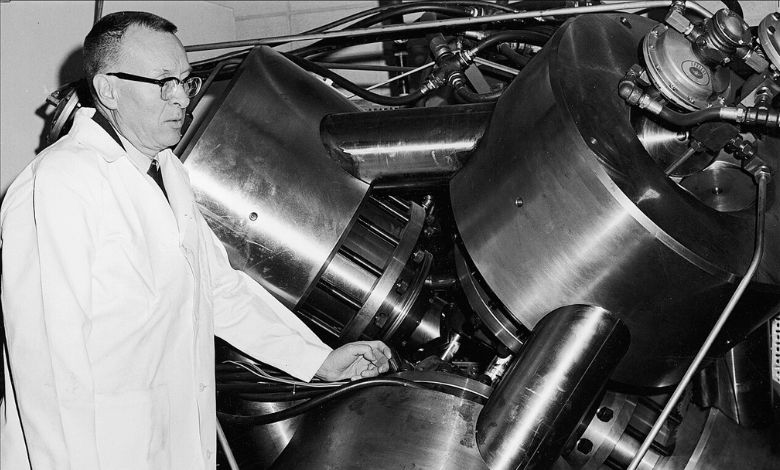
Howard Tracy Hall, commonly known as H. Tracy Hall or Tracy Hall, was an American physical chemist, inventor, and high-pressure materials researcher. He is best known for completing a successful and reproducible synthetic diamond experiment at the General Electric Research Laboratory on December 16, 1954.
Hall’s achievement depended on a high-pressure device known as the belt apparatus, which he designed to produce the extreme conditions required to transform carbon into diamond. His work helped move synthetic diamond production from uncertain laboratory experimentation toward a repeatable industrial process.
Although Hall played a central role in the breakthrough, he worked within General Electric’s Project Superpressure research group. Other important participants included Francis Bundy, Herbert Strong, Robert Wentorf, and project manager Anthony Nerad. An accurate account therefore recognizes both Hall’s decisive experiment and the collaborative scientific program surrounding it.
Hall later continued his research at Brigham Young University, developed additional high-pressure presses, taught chemistry, secured patents, and helped establish companies connected to industrial diamond technology.
Also Read: George Gipp Biography: Notre Dame Career, Death, and Legacy
Featured Snippet Section
Who was Tracy Hall?
Tracy Hall was an American physical chemist and inventor who pioneered reproducible synthetic diamond production. Working at General Electric, he completed a successful diamond-making experiment on December 16, 1954, using a high-pressure belt apparatus of his own design. He later became a professor and researcher at Brigham Young University.
Did Tracy Hall invent the synthetic diamond?
Tracy Hall developed the first widely recognized, verifiable, and reproducible synthetic diamond process at General Electric. However, he did not work alone. His experiment formed part of GE’s Project Superpressure, which included Francis Bundy, Herbert Strong, Robert Wentorf, and other researchers studying diamond formation under extreme pressure and heat.
How did Tracy Hall make synthetic diamonds?
Hall used graphite, a metallic catalyst, high temperature, and enormous pressure inside his belt apparatus. These conditions allowed carbon atoms to rearrange into diamond crystals. His process was important because it could be repeated, helping General Electric move from experimental research toward the commercial production of industrial synthetic diamonds.
Where did Tracy Hall study?
Hall attended Weber College before continuing his education at the University of Utah. He received bachelor’s and master’s degrees in chemistry and completed a doctorate in physical chemistry in 1948. After serving in the United States Navy, he returned to the university and conducted graduate work under chemist Henry Eyring.
What was Tracy Hall’s most important invention?
Hall’s best-known invention was the belt apparatus, a high-pressure device used in his successful synthetic diamond experiment. He later developed tetrahedral and cubic presses at Brigham Young University. These designs expanded the possibilities of high-pressure research and influenced the manufacture of diamonds and other advanced industrial materials.
Tracy Hall Profile Summary
| Field | Details |
|---|---|
| Full name | Howard Tracy Hall |
| Common name | H. Tracy Hall or Tracy Hall |
| Date of birth | October 20, 1919 |
| Place of birth | Ogden, Utah, United States |
| Date of death | July 25, 2008 |
| Place of death | Provo, Utah, United States |
| Age at death | 88 |
| Nationality | American |
| Profession | Physical chemist, inventor, researcher, and professor |
| Scientific fields | Physical chemistry, high-pressure research, and materials science |
| Known for | Developing a reproducible synthetic diamond process |
| Early college | Weber College |
| Higher education | University of Utah |
| Doctoral degree | PhD in physical chemistry, 1948 |
| Doctoral adviser | Henry Eyring |
| Military service | United States Navy |
| Major employer | General Electric Research Laboratory |
| Academic institution | Brigham Young University |
| Notable apparatus | Belt, tetrahedral, and cubic presses |
| Spouse | Ida-Rose Langford |
| Children | Seven |
| Major recognition | National Inventors Hall of Fame, 2010 |
Early Life and Background
Howard Tracy Hall was born on October 20, 1919, in Ogden, Utah. He grew up in nearby Marriott, a community in Weber County. Biographical accounts describe his early environment as rural and closely connected to farm life.
Hall reportedly became interested in scientists and inventors while he was young. Accounts of his childhood state that he hoped to work for General Electric, the company associated with inventor Thomas Edison. Such stories offer context for his later career, although they are mainly preserved through biographical and family recollections.
Detailed public information about Hall’s childhood, parents, and early household is limited. Some sources identify his mother as Florence Almina Hall, but comprehensive and consistent documentation of both parents is not widely available in major institutional profiles.
Education
Hall attended Weber College, the institution that later became Weber State University. He completed his studies there in 1939 before continuing his scientific education at the University of Utah.
At the University of Utah, Hall earned a bachelor’s degree in 1942 and a master’s degree in chemistry in 1943. His education was interrupted by military service during the Second World War. He served for approximately two years as an ensign in the United States Navy.
After returning to the University of Utah in 1946, Hall continued his graduate work under Henry Eyring, an influential physical chemist. Hall earned his doctorate in physical chemistry in 1948.
Some online profiles incorrectly list the Crocker Science Center as a school Hall attended. The Crocker Science Center is associated with the University of Utah and should not be treated as a separate educational institution or degree-granting university. Hall’s verified higher-education degrees came from the University of Utah.
Career and Professional Journey
General Electric Research Laboratory
Soon after completing his doctorate, Hall joined the General Electric Research Laboratory in Schenectady, New York. He became part of a research program known as Project Superpressure, which sought to create diamonds from carbon under controlled laboratory conditions.
Scientists already understood that natural diamond and graphite were both forms of carbon. The challenge was producing the extreme pressures and temperatures needed to change the atomic structure of graphite into diamond.
General Electric had invested in powerful equipment for this research, but Hall believed that existing systems were not sufficiently practical for consistent experimentation. He developed a smaller high-pressure device that became known as the belt apparatus.
The apparatus used strong anvils and a specially constructed reaction chamber to contain graphite, a metallic catalyst, and other materials under extreme heat and pressure. Hall’s design allowed researchers to maintain more controlled conditions inside the reaction cell.
The December 1954 Diamond Experiment
On December 16, 1954, Hall completed the experiment for which he became best known. After opening the reaction chamber, he identified small diamond crystals produced from carbon.
The importance of the experiment was not simply that diamond crystals appeared. Earlier researchers had reported possible diamond synthesis, but many such claims could not be reliably confirmed or repeated. Hall’s method produced a verifiable result that could be reproduced.
General Electric announced the synthetic diamond achievement on February 15, 1955. The company credited Hall along with team members Francis Bundy, Herbert Strong, and Robert Wentorf. Their research helped establish a practical high-pressure and high-temperature process for manufacturing diamonds.
Historical discussions have sometimes debated how credit should be distributed among the researchers. Available evidence supports Hall’s central role in completing the first successful reproducible run while also showing that he worked as part of an organized GE research group.
Brigham Young University
Hall left General Electric in 1955 and returned to Utah. He joined Brigham Young University as a chemistry professor and research director.
At BYU, he continued studying how materials behave under extreme pressure. He developed new equipment, including tetrahedral and cubic presses. These multi-anvil systems applied pressure to a sample from several directions, creating useful conditions for experimental chemistry and materials research.
Hall also taught students and supervised graduate researchers. His academic career helped transfer knowledge developed in corporate laboratories into university research and education.
Patents and Industrial Work
Hall received patents related to diamond synthesis and high-pressure technology. U.S. Patent No. 2,947,608, titled “Diamond Synthesis,” identified Hall as the inventor and described a method for converting nondiamond carbon into diamond.
U.S. Patent No. 2,947,610, titled “Method of Making Diamonds,” listed Hall, Herbert Strong, and Robert Wentorf as inventors. The process involved subjecting carbon and selected metallic catalysts to extreme temperatures and pressures.
Published biographical accounts state that Hall received 19 patents during his career. He also helped establish companies associated with industrial diamonds and high-pressure equipment.
In 1966, Hall worked with fellow Brigham Young University professors William Pope and Duane Horton to form MegaDiamond. He was also associated with the later development of Novatek, a company involved in advanced drilling and diamond-related technologies.
Major Achievements and Recognition
Hall’s principal achievement was the development of a reproducible process for making synthetic diamonds from carbon. This work contributed to the expansion of industrial diamond production.
Synthetic diamonds became valuable for cutting, drilling, polishing, grinding, and machining. Their hardness and thermal properties made them useful in manufacturing, mining, construction, electronics, and scientific research.
Hall received several professional honors:
- The American Institute of Chemists presented him with the Chemical Pioneer Award in 1970.
- The American Chemical Society gave him its Award for Creative Invention in 1972.
- He received the American Physical Society’s new-materials prize in 1977, later known as the James C. McGroddy Prize for New Materials.
- Utah awarded him the Governor’s Medal for Science and Technology in 1994.
- The University of Utah granted him an honorary science degree in 2004.
- The National Inventors Hall of Fame inducted him posthumously in 2010.
Weber State University also named the Tracy Hall Science Center in his honor. Opened in 2016, the facility recognizes Hall as a former Weber student and an important figure in synthetic diamond research. A large diamond press designed by Hall is displayed inside the building.
Personal Life
Hall married Ida-Rose Langford in 1941 while he was a university student. They had seven children and remained married until her death in 2005.
Public accounts describe Hall as an active member of the Church of Jesus Christ of Latter-day Saints. He served as a bishop and later completed church service in southern Africa with his wife.
These aspects of his life are documented in professional obituaries and institutional biographies. However, most of his family members lived outside public life, and detailed personal information about them is neither necessary nor well documented.
Hall died at his home in Provo, Utah, on July 25, 2008. He was 88 years old.
Also Read: Ronnie Platt Biography: Age, Kansas Career, and Songs
Philanthropy and Public Engagement
There is no widely documented evidence that Hall operated a major charitable foundation or organized a large public philanthropic program.
His most clearly recorded forms of public engagement were scientific education, university teaching, research supervision, religious service, and participation in professional scientific communities. He also contributed to the application of academic research through companies working with industrial diamonds and high-pressure equipment.
Descriptions of his church service indicate that he worked with community members and participated in overseas religious service. These activities may be discussed as public or community engagement, but they should not be presented as formal philanthropy without stronger documentation.
Public Perception and Misconceptions
Was Tracy Hall the sole inventor of synthetic diamonds?
Hall is frequently described as the inventor or father of synthetic diamond production. This description reflects the importance of his successful and reproducible experiment. However, it can hide the collaborative nature of the General Electric program.
Hall designed the belt apparatus and completed the decisive December 1954 experiment. At the same time, Bundy, Strong, Wentorf, Nerad, and other GE researchers contributed to the wider scientific effort. The most accurate description is that Hall was a central pioneer in reproducible synthetic diamond synthesis.
Did General Electric pay him only $10?
A widely repeated story claims that General Electric rewarded Hall with a $10 savings bond. This account has become associated with debates about how companies recognize employee inventions.
The reported savings bond should not be confused with Hall’s entire compensation, salary, patent arrangements, or later business earnings. Reliable public records do not provide a complete financial account of his employment or personal wealth.
Did Hall invent diamonds intended mainly for jewelry?
Hall’s early synthetic diamonds were small industrial crystals rather than polished gemstones designed for luxury jewelry. Their main importance was practical.
Industrial diamonds could be used in abrasives, cutting tools, drill components, and precision manufacturing. The modern market for gem-quality laboratory-grown diamonds developed through later advances in production and crystal growth.
Was Hall a physicist or a chemist?
Hall is sometimes described broadly as a physics researcher because his work involved extreme pressure and material properties. His formal training, however, was in physical chemistry.
Physical chemistry examines how physical principles affect chemical systems. Hall’s research naturally crossed the boundaries of chemistry, physics, engineering, and materials science, but “physical chemist” remains the most precise description of his professional background.
Privacy and Limited Public Information
Compared with modern public figures, Hall left a relatively limited public record outside his scientific work. Reliable sources document his education, marriage, military service, academic appointments, inventions, patents, awards, and immediate family structure.
Less information is available about his childhood relationships, private finances, personality, daily family life, or personal views unrelated to science and religion. Online net-worth estimates and detailed financial claims are not supported by authoritative records.
There is also limited consistent documentation about his parents. Biographical articles should avoid filling these gaps with assumptions or information copied from unsourced genealogy pages.
Legacy and Influence
Tracy Hall’s lasting importance lies in making diamond synthesis reproducible. Scientific discoveries become industrially useful only when researchers can repeat them under controlled conditions. Hall’s belt apparatus addressed that problem by providing a practical way to generate and contain extreme pressure and heat.
His work helped establish the high-pressure and high-temperature method, commonly known as HPHT synthesis. The method became a major foundation of industrial diamond manufacturing.
Hall’s later tetrahedral and cubic presses also influenced high-pressure research. Multi-anvil press systems allowed scientists and manufacturers to study and create materials under conditions that would otherwise be difficult to reproduce.
His career also demonstrates the connection between scientific theory and engineering design. Researchers had long understood that diamond was a form of carbon. The major obstacle was constructing equipment capable of creating the correct conditions safely, consistently, and long enough for the transformation to occur.
Hall’s influence extended across corporate research, university teaching, patent development, industrial manufacturing, and scientific entrepreneurship. The Tracy Hall Science Center, his patents, and his National Inventors Hall of Fame induction continue to preserve recognition of his work.
Frequently Asked Questions
When was Tracy Hall born?
Tracy Hall was born on October 20, 1919, in Ogden, Utah. He grew up in the nearby community of Marriott and later attended Weber College and the University of Utah.
When did Tracy Hall create a synthetic diamond?
Hall completed his successful and reproducible synthetic diamond experiment on December 16, 1954. General Electric publicly announced the research team’s achievement on February 15, 1955.
What was the belt apparatus?
The belt apparatus was a high-pressure device designed by Hall. It used strong anvils and a contained reaction chamber to expose carbon and a metallic catalyst to the heat and pressure required for diamond formation.
Why are synthetic diamonds important?
Synthetic diamonds are valued for their hardness, thermal conductivity, and resistance to wear. They are widely used in cutting, drilling, polishing, grinding, manufacturing, scientific instruments, and some electronic technologies.
Where did Tracy Hall work after leaving General Electric?
Hall joined Brigham Young University in 1955 as a chemistry professor and research director. He continued developing high-pressure equipment, teaching students, supervising research, and working on industrial applications.
When did Tracy Hall die?
Hall died on July 25, 2008, at his home in Provo, Utah. He was 88 years old.
Conclusion
Howard Tracy Hall was an American physical chemist whose work helped establish practical synthetic diamond production. His most important experiment took place at General Electric on December 16, 1954, when he produced diamonds through a process that could be verified and repeated.
Hall’s belt apparatus was central to the achievement, but the breakthrough also emerged from General Electric’s wider Project Superpressure research program. His later work at Brigham Young University expanded high-pressure technology through tetrahedral and cubic press designs.
Through his patents, teaching, inventions, and industrial activities, Hall influenced materials science well beyond the original diamond experiment. His legacy rests not on a single crystal, but on the creation of methods and equipment that made synthetic diamond production scientifically dependable and industrially useful.