


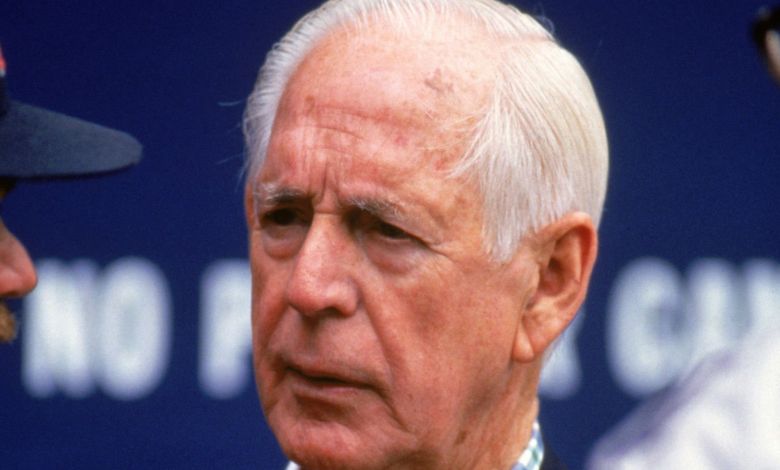
Jack Buck, born John Francis Buck, was an American sportscaster best known for his long association with Major League Baseball’s St. Louis Cardinals. Over nearly five decades in broadcasting, Buck became one of the most recognizable radio voices in American sports, especially for Cardinals fans who followed baseball through KMOX and the Cardinals Radio Network.
Although his career is most closely linked to baseball, Buck also worked on national football broadcasts, World Series coverage, All-Star Games, and other major sporting events. His play-by-play career earned him recognition from several major broadcasting and sports institutions, including the National Baseball Hall of Fame’s Ford C. Frick Award. This biography focuses on verified public information about his early life, education, broadcasting career, family, honors, public reputation, and lasting influence.
Also Read: Miranda Pak Biography: Terrence Howard’s Ex-Wife and Private Life
Featured Snippet Section
Who was Jack Buck?
Jack Buck was an American sports commentator and play-by-play announcer best known as the longtime radio voice of the St. Louis Cardinals. Born John Francis Buck in 1924, he built a broadcasting career that included Major League Baseball, NFL football, World Series broadcasts, and national radio and television assignments.
What was Jack Buck famous for?
Jack Buck was famous for his work announcing St. Louis Cardinals baseball games and for his memorable national sports calls. He became closely associated with Cardinals radio broadcasts, especially through KMOX. He also covered football, including Monday Night Football on CBS Radio and multiple Super Bowl broadcasts.
When was Jack Buck born and when did he die?
Jack Buck was born on August 21, 1924, in Holyoke, Massachusetts, United States. He died on June 18, 2002, in St. Louis, Missouri, at age 77. Contemporary reports stated that he had been hospitalized at Barnes-Jewish Hospital before his death.
Was Jack Buck related to Joe Buck?
Yes. Jack Buck was the father of Joe Buck, who also became a nationally known American sportscaster. Their connection is often mentioned in sports broadcasting history, but Jack Buck’s own career was already well established through decades of Cardinals baseball, CBS Radio, and national sports coverage.
What awards did Jack Buck receive?
Jack Buck received the Ford C. Frick Award from the National Baseball Hall of Fame in 1987 and the Pete Rozelle Radio-Television Award from the Pro Football Hall of Fame in 1996. He was also inducted into major broadcasting halls of fame and received lifetime achievement recognition in sports television.
Profile Summary
| Field | Details |
|---|---|
| Full Name | John Francis Buck |
| Known As | Jack Buck |
| Profession | Sportscaster, sports commentator, play-by-play announcer |
| Best Known For | St. Louis Cardinals radio broadcasts |
| Date of Birth | August 21, 1924 |
| Birthplace | Holyoke, Massachusetts, United States |
| Date of Death | June 18, 2002 |
| Age at Death | 77 |
| Place of Death | St. Louis, Missouri, United States |
| Nationality | American |
| Education | Ohio State University |
| Main Sports Covered | Baseball and football |
| Primary Team Association | St. Louis Cardinals |
| Notable Network Work | CBS Radio and CBS television assignments |
| Spouses | Alyce Larson; Carole Lintzenich |
| Children | Eight children, including Joe Buck |
| Parents | Earle Buck and Kathleen Buck |
| Major Honors | Ford C. Frick Award, Pete Rozelle Radio-Television Award, Radio Hall of Fame, NAB Broadcasting Hall of Fame, Cardinals Hall of Fame |
Early Life and Background
John Francis Buck was born on August 21, 1924, in Holyoke, Massachusetts. Public biographical sources identify his parents as Earle Buck and Kathleen Buck. Several accounts note that Buck was raised partly in Cleveland, Ohio, after his family moved there during his youth.
Available public information about his childhood is focused mainly on his early interest in sports broadcasting and his later path into radio. Unlike many modern public figures, Buck’s early private life is not extensively documented in accessible public records. For that reason, responsible biographical writing should avoid adding unsupported details about his childhood, family circumstances, or personal relationships beyond what has been verified.
Buck also served in the United States Army during World War II, a part of his life frequently mentioned in biographical accounts. His wartime experience preceded his formal development as a broadcaster and helped shape the timeline that eventually led him to Ohio State University.
Education
Jack Buck graduated from Ohio State University. His college years were important to his broadcasting development because he gained early microphone experience calling Ohio State basketball and football. This period gave him practical training in play-by-play work before he entered professional broadcasting.
Public sources do not provide extensive details about every stage of his schooling before college. The strongest documented education fact is his Ohio State University background, which is consistently cited by broadcasting and baseball institutions.
Career and Professional Journey
Jack Buck’s professional broadcasting career began before he became a permanent voice in St. Louis. After college, he worked in sports broadcasting roles connected to Cardinals farm clubs, including Columbus and Rochester. These early assignments gave him experience with baseball play-by-play and helped prepare him for major league broadcasting.
Buck joined the St. Louis Cardinals broadcast booth in 1954. At first, he worked alongside Harry Caray, one of baseball’s most recognizable announcers. After Caray’s departure, Buck became the Cardinals’ principal voice and continued to be associated with the club for decades. MLB’s all-time Cardinals broadcaster listing records Buck’s Cardinals broadcasting years as 1954–1959 and 1961–2001, showing the remarkable length of his connection to the franchise.
His role at KMOX radio was also central to his career. KMOX’s reach helped Cardinals broadcasts travel across a large portion of the United States, making Buck’s voice familiar to listeners far beyond St. Louis. For many fans, his broadcasts were part of the daily rhythm of baseball season.
Although baseball defined his public image, Buck was not limited to one sport. He worked on CBS Radio and television assignments and became known nationally through football coverage. He called Monday Night Football on CBS Radio for many seasons and was connected with Super Bowl broadcasts. His ability to move between baseball and football helped distinguish him from announcers known mainly for a single team or sport.
Buck’s best-known calls include moments from Cardinals history and national baseball broadcasts. His phrase “Go crazy, folks!” after Ozzie Smith’s home run in the 1985 National League Championship Series became one of the most remembered calls in Cardinals history. He also made widely remembered national calls during the 1988 World Series and 1991 World Series. These calls are often cited as examples of direct, concise sports broadcasting that captured the emotion of the moment without overwhelming the play itself.
Major Achievements and Recognition
Jack Buck received the Ford C. Frick Award from the National Baseball Hall of Fame in 1987. The award recognizes major contributions to baseball broadcasting, and it remains one of the most important honors for baseball announcers.
In football, Buck received the Pete Rozelle Radio-Television Award from the Pro Football Hall of Fame in 1996. This recognition reflected the significance of his work beyond baseball, especially his national football broadcasting.
Buck was also inducted into the Radio Hall of Fame in 1995 and later recognized by the NAB Broadcasting Hall of Fame. The National Sports Media Association lists him among its Hall of Fame honorees and notes additional recognition, including Missouri Sportscaster of the Year honors and lifetime achievement recognition in sports television.
The St. Louis Cardinals also included Buck in the inaugural class of the Cardinals Hall of Fame in 2014. His inclusion reflected his importance not as a player, but as a broadcaster whose voice became part of the franchise’s public identity.
Personal Life
Jack Buck was married twice. He married Alyce Larson in 1948, and that marriage ended in 1969. He later married Carole Lintzenich in 1969, and they remained married until his death in 2002.
Public records and widely reported biographical sources identify Buck as the father of eight children: Joe Buck, Jack Buck Jr., Julie Buck, Christine Buck, Beverly Buck, Bonnie Buck, Betsy Buck, and Dan Buck. Joe Buck became the most publicly known of his children because of his own career as a national sportscaster.
Reliable public information about Buck’s family life is limited compared with information about his broadcasting career. For that reason, a neutral biography should avoid speculation about family relationships and focus only on information that is publicly documented.
Philanthropy and Public Engagement
Jack Buck was also known for public and charitable engagement in St. Louis. Sports Broadcasting Hall of Fame material describes his involvement in charitable appearances and identifies the Cystic Fibrosis Foundation as one of his important causes. Public accounts also describe him as a visible civic figure in St. Louis, not only a broadcaster.
Because charity-related figures and details can vary by source, claims about the exact number of events or total funds raised should be used carefully unless directly supported by a reliable citation. What is well supported is that Buck’s public role extended beyond the press box and into community events.
Public Perception and Misconceptions
Jack Buck is widely remembered as the “Voice of the Cardinals,” but one misconception is that his career was only local. In reality, he also had significant national broadcasting work, especially through CBS Radio and CBS television. His assignments included major baseball and football events, making him a national sports media figure as well as a St. Louis institution.
Another misconception is that Buck was connected to the Cardinals as a player. He was not a Cardinals player; his role was as a broadcaster. His importance to the franchise came from decades of play-by-play work and the relationship he built with fans through radio.
A third misconception is that Jack Buck’s legacy exists mainly because of Joe Buck. Joe Buck’s career has kept the family name visible in modern sports media, but Jack Buck had already earned major honors and national recognition before his son became a prominent broadcaster.
Also Read: Amara Wayans Biography: Facts About Aja Metoyer’s Daughter
Privacy and Limited Public Information
Most available public information about Jack Buck centers on his professional career, honors, and public role in St. Louis. Details about his private family life, early schooling, and personal relationships are more limited. A fact-based biography should not fill those gaps with assumptions.
His health and death were reported by major news outlets at the time, but even those details should be handled with restraint. The most relevant verified facts are that he died on June 18, 2002, at age 77, after a period of hospitalization in St. Louis.
Legacy and Influence
Jack Buck’s legacy rests on three main areas: his long service to the St. Louis Cardinals, his national work across baseball and football, and his influence on the craft of play-by-play broadcasting. He represented a radio era in which announcers served as the main connection between fans and the game.
His style was built around timing, clarity, and the ability to match the importance of a moment. He did not need lengthy descriptions to make a call memorable. Many of his best-known lines were short, direct, and closely tied to the action on the field.
Buck also helped define the public identity of Cardinals baseball for multiple generations. His voice connected the team to listeners across Missouri, the Midwest, and other parts of the country reached by Cardinals radio. His recognition by baseball, football, radio, and broadcasting institutions shows that his impact extended beyond one franchise.
FAQ Section
What team is Jack Buck most associated with?
Jack Buck is most associated with the St. Louis Cardinals. He joined the Cardinals broadcast booth in 1954 and remained closely linked to the team for most of his career. His radio work made him one of the most recognized voices in Cardinals history.
Did Jack Buck only announce baseball?
No. Jack Buck was best known for baseball, especially Cardinals games, but he also announced football and other sports. His national work included CBS Radio’s Monday Night Football and Super Bowl broadcasts, along with World Series and other major baseball assignments.
Is Jack Buck in the Hall of Fame?
Jack Buck received several major hall of fame honors and broadcasting awards. He was the 1987 recipient of the Ford C. Frick Award from the National Baseball Hall of Fame and was also recognized by the Radio Hall of Fame, NAB Broadcasting Hall of Fame, and Cardinals Hall of Fame.
Conclusion
Jack Buck was one of the most important American sportscasters of the twentieth century. Born in Holyoke, Massachusetts, educated at Ohio State University, and professionally defined by his long association with the St. Louis Cardinals, he built a career that combined local loyalty with national reach.
His verified legacy includes decades of Cardinals broadcasts, major CBS assignments, the Ford C. Frick Award, the Pete Rozelle Radio-Television Award, Radio Hall of Fame recognition, and inclusion in the Cardinals Hall of Fame. While some private details about his early life and family remain limited in public sources, his professional record is well documented. Jack Buck remains remembered as a central voice in Cardinals history and a major figure in American sports broadcasting.